

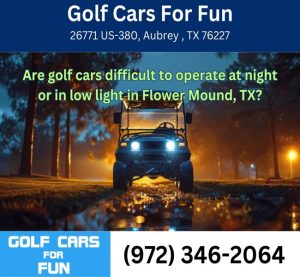
Golf cars are not inherently difficult to operate after dark, but stock models come with genuine limitations that can make low light conditions challenging in Flower Mound, TX. Most factory golf cars are built for daytime use on well maintained courses or private property, and their standard lighting packages reflect that narrow purpose. When residents, HOA communities, and commercial operators begin using these vehicles after sunset, those limitations become real safety and legal concerns. Whether you own a single cart, depend on a golf car rental for an event or seasonal use, or manage a fleet for a facility, understanding what changes after dark and how to address it is the foundation of responsible operation across Denton County.
The Honest Answer: Stock Golf Cars Have Real Limitations After Dark
How Factory Lighting Falls Short at Sunset
Most standard golf cars ship with minimal lighting configurations. A pair of small headlights and a basic rear light cluster are common, and while these are adequate for moving between holes on a bright afternoon, they are not engineered for roads, pathways, or parking lots after dusk. The beam spread is narrow, the throw distance is short, and there is typically no consideration for oncoming visibility at speed.
In Flower Mound, where neighborhoods blend residential streets with golf cart paths near parks and open green space corridors, dim factory lights create blind spots that neither the driver nor pedestrians can compensate for in real time. This is not a design flaw so much as a scope limitation. Factory engineers build for a controlled course environment, not a public North Texas neighborhood at 8:30 in the evening.
What Changes Between Daytime and Low Light Operation
Beyond the lighting hardware itself, several operational factors shift after dark that drivers do not always account for until they are already on the path:
- Depth perception decreases at lower light levels, making curbs, speed bumps, and uneven terrain harder to judge accurately.
- Peripheral vision narrows, reducing your ability to detect movement from side paths or driveways.
- Reaction time feels the same but is effectively slower because visual processing requires more cognitive effort in low visibility conditions.
- Other drivers and pedestrians cannot see your vehicle as early, compressing the shared window of time for mutual avoidance.
These are not golf car specific problems. They apply to any small, low profile vehicle traveling in reduced light. The difference is that golf cars sit lower to the ground and lack the mass, reflectivity, and visual profile of a standard automobile.
Night Specific Hazards Flower Mound Operators Need to Recognize
Residential Roads, Paths, and HOA Communities After Dark
Flower Mound has a well developed network of trails, sidewalk adjacent paths, and neighborhood roads that see consistent golf car traffic, particularly in communities where LSV permits or HOA approvals allow street use. After dark, these same routes present a layered set of hazards that daytime travel rarely surfaces:
- Unlit trail sections that cross drainage areas or transition from pavement to gravel without warning.
- Residential cross streets where vehicle headlights can momentarily blind a golf car driver who has no sunshield or visor protection.
- Pedestrian foot traffic including joggers and cyclists who may not be wearing reflective gear.
- Wildlife crossings that are far more active at night across North Texas, particularly deer and small animals.
For homeowners using a cart to reach a neighbor, a community mailbox, or a nearby park, these conditions require more than a casual approach to operating safely.
Golf Courses, Campuses, and Event Venues: The Commercial Risk Picture
Commercial operators face a different and more complex version of this challenge. Golf courses running twilight rounds, corporate campuses using cart fleets for transport, and event venues deploying carts for guest mobility all share one exposure in common: multiple operators using the same vehicles across shifting light conditions, often with passengers who have little experience on a golf car.
Why Fleet Operators Carry Greater Liability Exposure at Night
When a single privately owned vehicle is involved in a nighttime incident, liability is relatively contained and traceable. When a fleet is involved, the liability picture expands quickly. Fleet operators are responsible not just for the mechanical condition of each cart but for the visibility and lighting compliance of every unit in service. In Texas, that distinction matters legally, particularly when road use is part of the operational footprint and passengers are being transported as part of a commercial service.
Texas Law and Local Rules Governing After Hours Golf Car Use
LSV Classification and What Texas Requires for Road Use
Texas Transportation Code Chapter 551 governs the use of golf carts and Low Speed Vehicles on public roads. To operate legally on roads with posted speed limits at or below 35 mph, a golf car must meet LSV requirements. Those requirements include the following:
- Functional headlights and taillights
- Turn signals, both front and rear
- Reflectors
- A windshield
- A VIN and current registration
Operating a stock golf car on a public road after dark without meeting these specifications is a moving violation under Texas law, and Flower Mound municipal ordinances align closely with the state framework on this point. This is not a gray area.
HOA Policies and Community Guidelines That Affect Night Operation
Beyond state law, many HOA communities in Flower Mound maintain their own covenants governing golf car use within their boundaries. Some restrict hours of operation entirely after a certain time in the evening. Others require specific lighting standards as a condition of approval for street or path access. Before assuming your cart is cleared for nighttime use in your neighborhood, reviewing your HOA documents or contacting your association directly is a critical and often skipped step.
When Lighting Equipment Becomes a Legal Requirement
The threshold is not ambiguous under Texas law. The moment a golf car transitions from private property to a public road or shared community path that connects to public roads, the lighting and equipment requirements of the Transportation Code apply. Headlights and taillights are not optional accessories at that point. They are legal prerequisites, and HOA rules may impose an even higher standard in some communities.
How to Make Your Golf Car Night Ready and Compliant
Lighting Upgrades That Deliver the Most Impact
The good news is that addressing the lighting gap on most golf cars is straightforward, and the aftermarket for golf car lighting accessories is well developed. The right starting point depends on your current setup and your intended routes, but the following upgrades address the most common gaps.
LED Headlights and Taillights
LED lighting represents the single most meaningful upgrade for nighttime golf car use. Compared to standard incandescent bulbs, LED units produce a whiter, broader beam that improves road surface visibility at shorter distances and extends illumination further ahead of the vehicle. They also consume significantly less battery power, which matters on electric carts running extended nighttime routes where range is already a variable. The color temperature of a quality LED headlight also reduces eye fatigue compared to the yellow tone of older incandescent options.
Turn Signals, Brake Lights, and Reflectors
Turn signals and brake lights are not optional accessories when your cart will travel a public road after dark. These components are required under Texas law, and they serve a practical purpose that goes beyond compliance. A vehicle behind you on a neighborhood road needs advance notice of your intentions. Brake lights give that notice. Reflectors add a passive safety layer that costs almost nothing to install but increases your visibility to other drivers significantly when headlights sweep across your vehicle from any angle.
| Common Nighttime Challenge | Recommended Solution |
|---|---|
| Weak or narrow factory headlight beam | Upgrade to a wide spread LED headlight kit rated for low speed vehicle use |
| No turn signals or brake lights on stock cart | Install a turn signal and brake light kit to meet Texas LSV road use requirements |
| Low rear visibility on shared paths and roads | Add rear facing LED light bars and body mounted reflector strips for passive visibility |
| Reduced depth perception in low light conditions | Reduce operating speed by 20 to 30 percent and avoid unlit trail segments after dark |
| Unfamiliarity with HOA or local night operation rules | Review community covenants and confirm with your HOA before operating after sunset |
Visibility Accessories That Extend Your Safety Margin
Beyond the core lighting upgrades, a few additional accessories round out a solid nighttime setup that covers both active and passive visibility:
- Rear facing amber or red LED light bars mounted low on the cart body increase rear visibility across paths and roads.
- Side reflector strips mounted along the vehicle body improve lateral visibility to crossing traffic.
- A slow moving vehicle triangle or placard signals to approaching drivers that your cart operates well below highway speed, which is particularly valuable on roads where cars may be moving at 30 to 35 mph.
Operational Habits That Reduce After Dark Risk
Equipment matters, but behavior matters equally. Experienced low light operators consistently follow a set of practices that reduce exposure regardless of how well equipped their cart is:
- Reduce speed by 20 to 30 percent compared to your standard daytime routes on the same paths.
- Avoid trail segments or roads without streetlights or path lighting unless the cart carries a full lighting upgrade.
- Communicate turns and stops early using your signals, even when no other vehicles appear to be nearby.
- Never carry passengers who are unfamiliar with nighttime riding conditions without a brief orientation before departure.
- Confirm that all lighting components are functional before each nighttime trip, not just periodically during routine maintenance cycles.
Residential vs. Commercial: Matching Your Setup to Your Use Case
What Homeowners and HOA Residents Should Prioritize
If you use your cart primarily for neighborhood travel in Flower Mound, the priority list is clear and manageable. Bring your lighting into compliance with Texas LSV requirements, confirm your HOA’s specific rules around night operation, and build the operating habits above into your regular routine. Those three steps address the vast majority of residential nighttime risk without requiring a comprehensive fleet management approach or a large investment in accessories.
The key mistake most residential owners make is assuming daytime approval from their HOA automatically extends to nighttime operation. In many Flower Mound communities, it does not. A brief conversation with your association before your first evening run can prevent a compliance issue that is far more inconvenient to address after the fact.
Fleet and Facility Managers Planning for Consistent Night Use
For commercial operators running golf car fleets across a golf course, campus, or event property, the approach needs to be systematic rather than cart by cart. Every unit in the fleet should be audited against Texas lighting requirements before nighttime deployment begins. Operator training should include a dedicated module on low light conditions, speed management, and passenger safety. A proactive maintenance schedule that keeps all lighting systems in verified working order is not optional when liability exposure is part of the equation and multiple users are operating the same vehicles across a single evening.
Key Takeaways
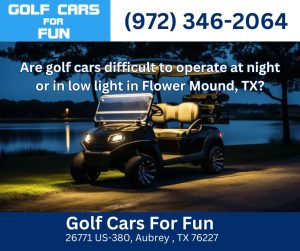
Operating a golf car after dark in Flower Mound, TX is absolutely manageable, but it is not the same experience as daytime operation, and treating it as such creates real risk. Stock lighting limitations, Texas road use requirements, HOA covenant rules, and the physical realities of low visibility driving all require attention before the sun goes down. The path forward is consistent whether you are a homeowner navigating a neighborhood path or a fleet manager running carts across a commercial property: upgrade your lighting, understand your legal obligations, and develop the operating habits that protect everyone on the road or trail.
Golf Cars For Fun is here to help Flower Mound residents and businesses get the most from their golf car experience, day or night. If you have questions about making your cart night ready or want to explore rental and fleet options designed with safety in mind, reach out directly or visit golfcarsforfun.net to learn more about what is available for your specific situation.